Rent Concessions or Lower Rent? How Phoenix MULTIfamily Owners Should Fill Units in 2026
Rent concessions are everywhere in Phoenix right now, and if you own a fourplex, a 12-unit, or a 40-unit building, you have probably wondered whether you should match them. A rent concession is a one-time incentive, like a free month, that gets a lease signed without changing the rent in the lease. Lowering the rent is the other option, and the two are not the same thing on your books. This guide walks through the net effective rent math on a real Phoenix number, what the latest vacancy data says, and what we try before giving away any rent at all. If you would rather have someone run these numbers on your building, that is part of our Phoenix property management work, and the full list of what we handle is on our services page.
Why rent concessions are showing up all over Phoenix
Phoenix built a lot of apartments over the last few years, and the market is still working through them. CoStar put the Phoenix MULTIfamily vacancy rate at 10.7 percent as of September 2026. That is down from 12.5 percent a year earlier, so things are moving the right way, but it is still near the highest level since the Great Recession and a lot of empty units are competing for the same renters. Average asking rent across the metro was $1,573 per month, down 1.1 percent over the past 12 months. Effective rent, which is what owners actually collect after concessions, fell 3.6 percent.
The supply is real and local. CoStar counts about 65,000 units delivered across the Valley over the past three years, the largest delivery schedule since the 1980s, with the heaviest building in Downtown Phoenix, Tempe, and the West Valley. When a new community has hundreds of doors to fill at once, the owner uses free rent to fill them quickly. Those offers then become the comparison point for every renter shopping in Tempe, Mesa, Chandler, Gilbert, Scottsdale, and central Phoenix, including the ones looking at your building.
CoStar measures the concession directly. Average asking rent is $1,573 and average effective rent is $1,433. That gap of about 9 percent is the concession, and it works out to a little more than one free month on a 12-month lease. Measured the same way, as the gap between asking and effective rent, it varies by submarket: about 9.3 percent of asking rent in Tempe, 9.1 percent in Gilbert, 8.3 percent in Chandler, and 10 percent in Downtown Phoenix, while Camelback and Old Town Scottsdale sit closer to 5.5 percent. CoStar describes four to eight weeks of free rent as typical at stabilized communities, with 10 or more weeks becoming more common at new builds.
Listing data points the same way. Rental Beast, which pulls its data from the Arizona Regional Multiple Listing Service, found that 65.8 percent of Phoenix rental listings offered some kind of concession in the second quarter of 2026, up 9.9 percent from a year earlier. So the CoStar figure tells you how big the typical discount is, and the Rental Beast figure tells you how many landlords are offering one.
There is good news in the same data. Net absorption, which is the change in occupied units, reached 23,771 units over the past 12 months, the highest on record, against 18,517 units delivered. About 16,000 units are under construction, down more than 50 percent from the peak. Renters are filling the new buildings and fewer new ones are coming. CoStar also puts stabilized vacancy, which leaves out new buildings still leasing up, at 7 percent or lower in Chandler, Gilbert, and Scottsdale. The pressure is easing, but it has not gone away, so the decision in front of you this fall is still a real one.
Rent concession vs. lowering the rent: what is the difference?
A rent concession is temporary. The lease still says $1,573. You just collect less during this lease term, because one month is free or a credit was applied at move-in.
A rent reduction is a new, lower rent for the whole lease. If you drop the unit to $1,473, that is the number on the lease, on your rent roll, and on the renewal offer you send next year.
Two more terms help here:
- Gross rent (also called face rent or asking rent) is the monthly rent written in the lease.
- Net effective rent is what you really collect per month once the concession is spread across the lease term.
The formula is simple. Take the total rent you will collect over the lease, subtract the value of the concession, and divide by the number of months. That number is what you should compare across options, because it is what lands in your account.
The math on a $1,573 Phoenix unit
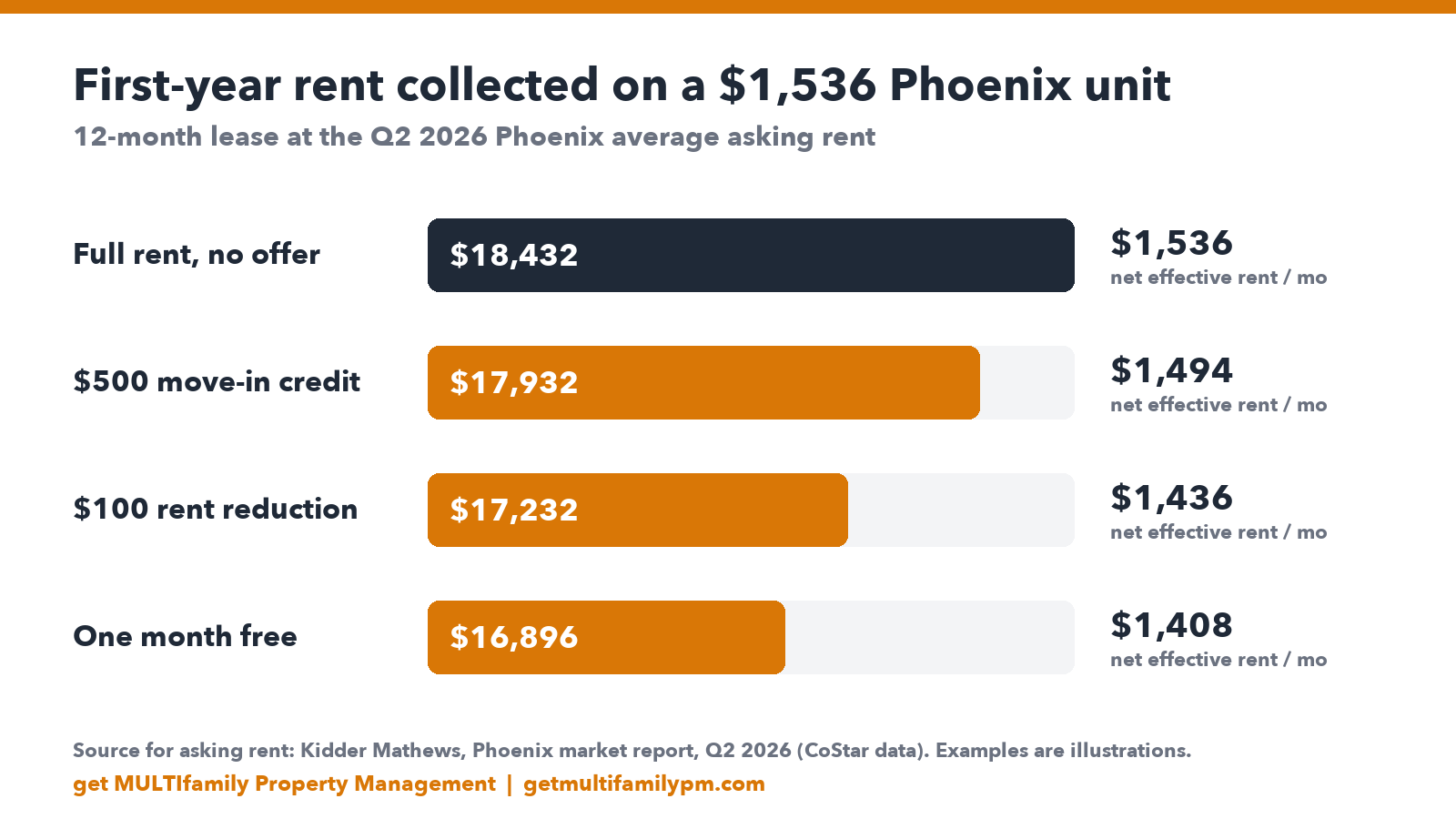
Here is how four common choices play out on a unit at the Phoenix average asking rent, on a 12-month lease.
| Option | Rent in the lease | Collected in year one | Net effective rent | Renewal starts from |
|---|---|---|---|---|
| Full rent, no offer | $1,573 | $18,876 | $1,573 | $1,573 |
| $500 move-in credit | $1,573 | $18,376 | $1,531 | $1,573 |
| $100 rent reduction | $1,473 | $17,676 | $1,473 | $1,473 |
| One month free | $1,573 | $17,303 | $1,442 | $1,573 |
A few things stand out. Notice that one month free lands at a net effective rent of $1,442, almost exactly the $1,433 average effective rent CoStar reports for the whole market. In other words, the typical Phoenix operator is already giving away about a month.
A free month costs exactly one month of vacancy. At $1,573, each empty day costs about $52. If a free month gets the unit leased 30 days sooner than it would have leased otherwise, you broke even. If it only saves you 10 days, you paid $1,573 to save about $524. The offer only makes sense when the unit would really have sat.
A modest rent cut is cheaper in year one. Dropping $100 costs $1,200 over the lease, which is less than the $1,573 a free month costs. That surprises a lot of owners, because a free month sounds smaller than it is.
The rent cut follows you into year two. Say you raise rent 3 percent at renewal. The unit that stayed at $1,573 goes to about $1,620. The unit you cut to $1,473 goes to about $1,517. That is a gap of roughly $103 a month, or about $1,236 over the second year, and it carries forward every year after. If the resident renews even once, the rent cut has already cost more than the free month did.
So the honest answer is that it depends on two things you can estimate: how many days the unit would sit without the offer, and how long you expect this resident to stay.
When a concession makes sense, and when it does not
A concession is usually the better tool when:
- The unit has already been vacant for a few weeks at a fair price and showings are slow.
- Several units are coming open at once and you need to stagger them.
- You are heading into the slower leasing months and want the lease signed before the holidays.
- A new community nearby is advertising free rent and your rent is otherwise in line with comparable buildings.
Lowering the rent is usually the better tool when:
- The unit is priced above what similar units nearby are really leasing for. A concession will not fix a price that is simply too high, because renters filter by monthly rent when they search, and your listing may never show up in their results. Our guide on how to price your rental covers how to check this.
- Your own records show that residents who came in on a big concession tend to leave at the end of the first term.
Sometimes the right answer is neither. If the unit is priced correctly and is not getting traffic, the problem is more often the photos, the listing, or how fast someone answers the phone. We covered the listing side in the best way to market your rental property.
The renewal problem nobody mentions
Here is the part that catches owners a year later. A resident who got one month free has been paying an effective $1,442 a month. At renewal, the lease rent is $1,573, and if you add even a small increase, the jump feels like 9 percent or more to them, even though the lease rent barely moved. Some will leave over it, and then you are paying for another turn, another vacancy, and maybe another concession.
You can soften this in a few ways. Spread the concession across the lease as a monthly credit instead of giving it all up front, so the resident is used to a number closer to the real rent. Be clear in writing at signing about what the rent will be after the offer ends. And start the renewal conversation 90 days out, not 30, so there is time to talk it through. Keeping a good resident is almost always cheaper than finding a new one, which is the whole point of our piece on long-term tenants.
Put it in writing and offer it evenly
Two housekeeping items protect you.
First, write the concession into the lease or a signed addendum. State the dollar value, when it applies, and what happens to it if the resident ends the lease early. A verbal promise of a free month is a dispute waiting to happen. Our overview of what belongs in a lease agreement is a good starting point, and your attorney should review any repayment language before you use it.
Second, offer the same deal to every qualified applicant for the same unit type during the same period. Deciding case by case who gets the free month is how owners end up on the wrong side of a fair housing complaint. Set the offer, set the dates, write it down, and apply it to everyone. We have a plain-language summary of the Arizona Fair Housing Act if you want a refresher.
One smaller note for your bookkeeping. Arizona ended the residential rental tax on January 1, 2025, so a concession no longer changes a city tax calculation on long-term residential rent. If your leases or ledgers still show that line, our post on the Arizona residential rental tax change explains what to clean up.
What we try before giving away rent
In our experience providing MULTIfamily property management across the Valley since 2016, most vacancy is lost in the days nobody is counting. These are the things we look at first, because they cost less than a free month.
- Turn time. Every day between move-out and rent-ready is a $52 day. We own our maintenance company, Fix MULTIfamily, so make-ready work is scheduled by our own licensed team and does not wait on a vendor's calendar.
- Response time on leads. A renter who asks about three apartments usually tours the first one that answers. We use RentEngine for leasing so inquiries get a fast reply and showings get booked without phone tag.
- Pricing against real comparable units. Not the asking rent down the street, but what is leasing, net of the offers those buildings are making.
- The listing itself. Current photos, an accurate description, and the details renters filter by.
- Renewals first. The cheapest unit to fill is the one that never goes vacant. A fair renewal offer made early beats a concession to a stranger.
- A small, targeted offer last. If the unit still needs help, a modest move-in credit with a clear end date usually does the job for less than a full free month.
If you work through that list and the unit is still sitting, a concession is a reasonable business decision. Just make it with the math in front of you and not because the new building down the road is doing it. Owners who want a wider view of the income side can also read our guide on how to increase NOI.
Getting a second set of eyes on your building
Every building is different. A 1970s 12-unit in Mesa does not compete with a brand new tower in Downtown Tempe, and it should not try to match its offers. What matters is your rents against your real comparables, your days vacant, and how your renewals are going. If you want us to look at those numbers with you, reach out through our contact page or call (480) 795-7938, and we will put together a rental analysis for your property.
This guide was written in September 2026. Market figures come from CoStar's Phoenix MULTIfamily market report dated September 1, 2026, and the Rental Beast Phoenix rental market report for the second quarter of 2026 (Arizona Regional Multiple Listing Service data). Dollar examples are illustrations, not a quote or a forecast. This article is general information and is not legal or tax advice.
Frequently asked questions
What is a rent concession?
A one-time incentive a landlord gives to get a lease signed, such as one month free or a move-in credit. The rent in the lease stays the same. Only the total collected during that lease term goes down.
What is net effective rent?
The average monthly rent you actually collect after concessions are spread across the lease. On a 12-month lease at $1,573 with one month free, you collect $17,303, so the net effective rent is $1,442.
Is it better to offer one month free or lower the rent?
It depends on how long the unit would sit and how long the resident is likely to stay. A free month on a $1,573 unit costs $1,573 in year one and keeps renewal rent at $1,573. A $100 cut costs $1,200 in year one but lowers the base for every future increase.
How common are rent concessions in Phoenix right now?
CoStar reported average asking rent of $1,573 against average effective rent of $1,433 as of September 2026, a gap of about 9 percent, or roughly one free month on a 12-month lease. Rental Beast found that 65.8 percent of Phoenix rental listings offered a concession in the second quarter of 2026.
How much does a vacant unit cost per day in Phoenix?
Divide monthly rent by 30. At the Phoenix average asking rent of $1,573, that is about $52 a day before utilities, turnover work, and marketing.
Do I have to offer the same concession to every applicant?
Offer the same terms to every qualified applicant for the same unit type during the same period, and put it in writing. Uneven offers with no documented business reason invite a fair housing complaint.